
Services
At HSEQ ENFOQUE Y SOLUCIONES SAS, we are dedicated to providing occupational medical examinations for entry, periodic retirement, and post-disability; consulting and auditing of management systems; promotion and prevention activities; and hygiene studies. We are committed to customer satisfaction, complying with legal and regulatory requirements, and employing competent personnel who carry out their activities according to the needs and expectations of our clients, whose main value is confidentiality.

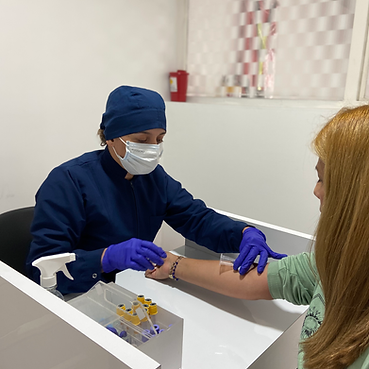
Laboratory and Sampling
This is a specific workplace setting where medical examinations are conducted to monitor the health of employees, especially those who are exposed to work-related risks. These examinations include blood, urine, and other biological samples that help identify potential adverse effects caused by exposure to harmful substances, occupational infections, or work-related health problems. The purpose is to prevent illness, monitor worker health, and ensure compliance with occupational safety and hygiene regulations.
Optometry and Visiometry
OPTOMETRY
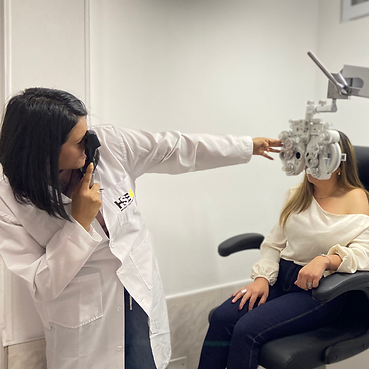
An optical exam is a comprehensive examination performed by an optometrist to assess a person's overall eye health and visual ability. This analysis is not limited to measuring vision clarity but also involves a series of tests that analyze different aspects of the visual system, ensuring that the patient receives the appropriate treatment to correct vision disorders or prevent eye conditions.
The evaluation begins with a thorough interview, where the optometrist collects information about the patient's medical and ocular history, family history, and any symptoms such as eye discomfort, blurred vision, eye strain, or difficulty distinguishing between near and far objects. This initial information is crucial for guiding the specific tests that will be performed later. The most common evaluations included in the optometric exam include:
Evaluation of visual acuity
Refraction test
Binocular vision test
Eye health inspection
Depth perception
Ocular motility
Assessment of color perception
Review of eye coordination and focus
VISIOMETRY
Visiometry is a specific type of medical examination used to measure a person's visual abilities, providing important information about their eye health. This procedure focuses on different aspects of vision, covering both distance and near vision, allowing visual performance to be assessed in various situations and distances. This test analyzes visual acuity, i.e., the clarity of vision.
Likewise, vision testing includes the ability to recognize colors, which helps detect potential problems with color perception, such as color blindness or difficulty differentiating certain shades. Another important element examined during vision testing is depth perception, a fundamental visual function for daily and professional activities, such as driving, operating machinery, or performing tasks that require spatial precision. The exam determines whether the patient needs corrective lenses in their daily life.

Speech Therapy
AUDIOMETRY
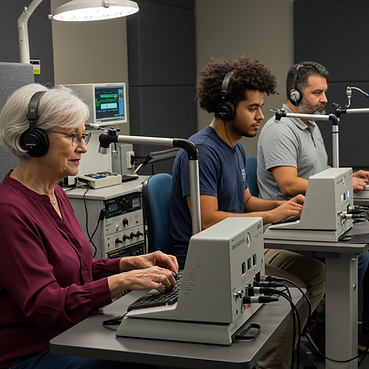
This is an evaluation that assesses a person's ability to perceive sounds at different pitches and intensities. During this test, the patient is fitted with headphones that emit pure tones ranging from very high-pitched to very low-pitched sounds. The patient must raise his or her head each time he or she hears a sound, which helps the specialist determine the hearing threshold, that is, the minimum sound level the person can detect. This test is performed in a quiet, controlled environment, usually within a soundproof booth.
The main objective of audiometry is to identify whether there is hearing loss and, if so, to determine its type and severity. It is an essential tool in medical practice, as it allows for distinguishing whether the hearing loss is conductive (when the problem occurs in the outer or middle ear) or sensorineural (when it affects the inner ear or auditory nerve). The results are displayed in a graph called an audiogram, which helps professionals understand the patient's hearing status and determine appropriate treatment, such as the use of hearing aids or specific medical treatments.
VOICE EVALUATION
This is a clinical evaluation performed by a speech-language pathologist to identify possible communication, speech, and voice disorders. This examination is personalized and varies depending on the patient's age, reason for consultation, and needs. It generally begins with an interview to determine speech development, vocal and social medical history, followed by a series of questions and/or specific tests that assess communicative and functional voice skills.
Occupational Medical Examination
The occupational medical examination is performed by experts in this field, with the training, experience, and expertise necessary to assess the physical condition of workers, taking into account their work environment. Each consultation takes approximately 20 to 25 minutes, sufficient time for a thorough analysis of the patient. During this process, several tests are performed and the employee is interviewed to assess key aspects of their health, taking into account the specific hazards of their role.
Once the review is complete, a Certificate of Fitness for Work is issued. This official document confirms whether the employee is physically and mentally fit to perform their duties safely and efficiently. This certificate becomes a fundamental part of the employee's occupational health record, a file that records all the examinations, diagnoses, and checkups performed over time, ensuring their health and preventing potential work-related illnesses or incidents.

Spirometry
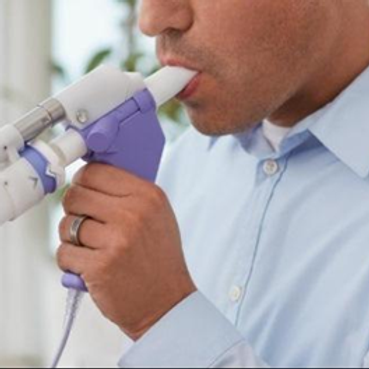
This test is used to analyze the lung function of workers, particularly those who come into contact with potentially damaging elements, such as dust, gases, or chemicals. This assessment quantifies the amount and speed of air a person is able to inhale and exhale, providing essential information about their respiratory health. It is performed in industries such as mining, construction, and the chemical industry, and its purpose is to identify respiratory problems resulting from occupational exposure, such as COPD or occupational asthma.
The process involves the worker taking a deep breath and then forcefully exhaling the air using a spirometer, which captures various important parameters, such as forced expiratory volume in 1 second (FEV1) and forced vital capacity (FVC). This test is crucial for both the prevention and early detection of lung diseases and for monitoring workers' health over time.
Hygienic Measurements
We conduct the necessary hygiene studies to manage your organization's risks and comply with legal requirements, including:
Hygienic Noise Measurements - Sound Level Measurements
Hygienic lighting measurements
Hygienic measurements of particulate matter
Our engineers have extensive experience conducting hygiene studies, and we employ properly calibrated equipment. Along with the report, we provide copies of the calibration certificates for the equipment used and a copy of the occupational health and safety license of the responsible professional.


Audits in Management Systems
Audits of management systems (such as quality, environment, occupational health and safety, information security, among others) are structured assessments that seek to verify whether a management system:
Complies with criteria and requirements (ISO standards, legislation, internal policies).
It works efficiently, being continuously maintained and improved.
They are systematic, documented, independent and objective processes, designed to collect evidence on how a management system operates, comparing it with established criteria.
Types of audit:
Internal: organized by the company itself (competent internal auditors) to assess continuity, effectiveness and compliance.
External: carried out by independent third parties (e.g. ISO certifiers), which issue a conformity report.
Regulatory Framework
They are guided by the international standard **ISO 19011:2018**, adopted in Colombia (NTC-ISO 19011), which establishes principles, planning, execution, competencies, and monitoring. It also integrates with national decrees (such as Decree 1072 of 2015) and sector-specific standards.
Process phases (according to ISO 19011):
Planning: preparation of the annual program, definition of scope, frequency, criteria and assignment of auditors.
Execution: formal opening, document review, interviews, process observation and recording of findings.
Audit report: document with non-conformities, observations and opportunities for improvement.
Follow-up and closure: Verifies that the organization implemented corrective actions within the established timeframe and closes the findings to its satisfaction.
Psychosocial Risk Studies
It is a mandatory assessment that seeks to identify work conditions that may affect employees' mental health and well-being, such as workplace stress, harassment, workload, or lack of control over tasks.
In Colombia, this is done with tools defined by Resolution 2646 of 2008. Two types of instruments are applied:
Intra-job assessment: measures factors within the workplace.
Extra-work assessment and perceived stress: analyzes personal and social factors outside of work.
The assessment is conducted by a licensed occupational health professional, and confidentiality is guaranteed. Based on the results, the company must implement intervention plans to prevent and control psychosocial risks.

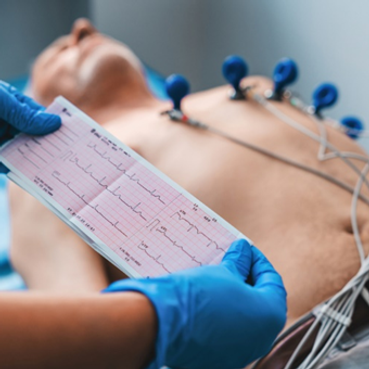
Electrocardiogram
It is a medical test that records the heart's electrical activity quickly, safely, and noninvasively. It is used to detect abnormal rhythms (arrhythmias), problems in electrical conduction, damage to the heart muscle, or signs of a heart attack, to guide urgent or preventive medical decisions.
The patient lies on a table and electrodes (small adhesive patches) are placed on the chest, arms, and legs. These electrodes are connected to a device that records the heart's electrical signals. It is a quick, painless, and noninvasive procedure that usually takes between 5 and 10 minutes.